
The Truth about the Stages of Grief

Irene Rowland MS, NCC, LPC
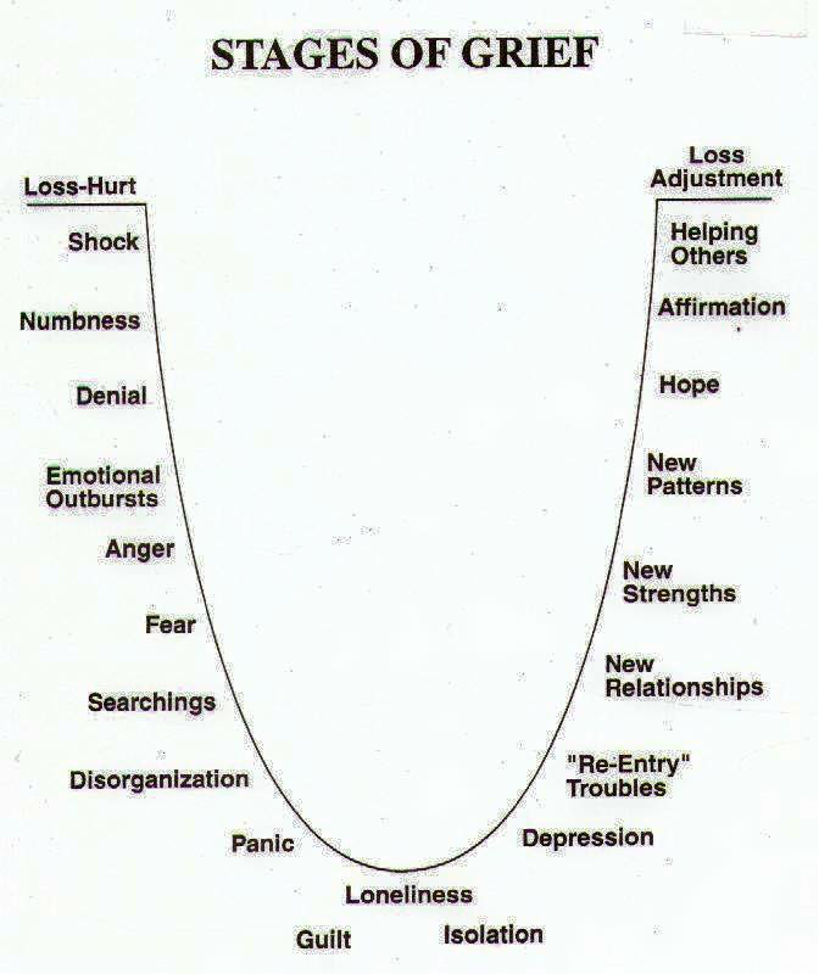
A diagram showing the different stages of grief

There are many models for the stages of grief. The horseshoe shaped diagram is my favorite and I believe it to be the most realistic. Grief is not linear. People do not proceed through each stage in a neat, orderly fashion. Typically, stages are sometimes skipped and then returned to later, as well as stages being returned to multiple times. This can happen long after a person thought they had worked through that particular stage. Just as the traditional 5 stages of grief by Elizabeth Kubler Ross are not a simple progression through the steps, neither are the many steps in the horseshoe model. If you drew a continuous line of how the steps might go for an individual, you would see that with all the jumbled directions going across and up and down the graph, it would look like a bunch of tangled thread. For many, that’s what grief really looks like.


The Descent of Loss

It can be a slow descent or a rapid plunge to the depths of grief. As stated already, we may or may not experience all of these stages and not necessarily in the order shown in the diagram. The tumble down to loneliness, guilt and isolation can be quite rough which almost makes those lows look restful compared to what it took to get there.


Shock, Numbness, Denial

It’s typical to be in a bit of a fog after you get the news of a significant loss, whether that’s of a loved one’s death, a job loss, a serious health diagnosis or any other kind of change that could be considered life changing. Grief is a natural response to the loss of how you thought things would continue to be and the future you expected.


Emotional Outbursts, Anger, Fear

Grievers can be easily triggered. Some losses are traumatic. With trauma, often

there is hypervigilance. The fight or flight instinct is revved up, as though we must

be on the lookout for any impending dangers at all times. We have all experienced

reactions from people that seem disproportionate to a situation. These emotional

outbursts are sometimes due to grief. The increased levels of cortisol when a

person is in this escalated state of vigilance causes a lot of wear and tear on one’s

body and mind. As a result, anxious, angry, or fearful people are perpetually

emotionally and physically drained. This of course can lead to impaired judgement

and become a vicious cycle. When there’s an anger response to grief, it can be

directed toward others or oneself. Anger turned inward is one of the definitions of

depression. The anger is sometimes directed toward the person who died, the boss

who did the firing, the spouse who left or sometimes toward those who played

“supporting roles” because it’s too difficult to be angry with the source of our angst.

Fear drives the thoughts and beliefs of some of the irrational actions and behaviors of a person experiencing a significant loss. A typical piece of advice after a significant loss is to wait at least a year before implementing any big changes such as moving or a change in career. Part of the reasoning for waiting is that the individual will be further along the healing path which usually means that fear is not as much a part of one’s reasoning process.


Searchings, Disorganization, Panic 

Trying to make sense of our pain, of the unexpected tragedies, of man’s inhumanity to man, or any number of other baffling incidences in life, is also a natural reaction. We often feel we can bear a crisis more easily if we can find some purpose in the suffering. Of course, there can be redemption in suffering, miracles can occur in disastrous situations, good can triumph over evil and all of this can be appreciated in retrospect. It is often quite difficult to discern any of this in the midst of the difficulties. Further down the road of one’s healing journey, these treasures can be discovered. I have found that the person who grieves must discover these on their own, rather than having others point them out, because they only sound like empty platitudes coming from others.


Disorganization is part of the mental fog and lack of clarity during the depression of grief. Often a person in this state may be unsure of the day of the week or even unclear of the status of the basic things that they normally could keep track of, such as whether they remembered to take a shower or eat lunch. It can be very confusing to find oneself acting and thinking in ways that are so untypical of the usual way of doing things. Often the energy isn’t there to even be concerned about the discrepancy of who they knew themselves to be and who this stranger in the mirror is now. Panic can set in when this disconnect is truly realized. There can be a fear that the old familiar self may not reemerge. Panic can be the answer to all the unanswered questions of what the future might hold. There can be the fear that things will always be this disjointed and hard to understand, that life as one knew it, is gone.


Guilt, Loneliness, Isolation, Depression       

The situations and emotions that grief entails often bring a person to their knees. This is at the bottom of the diagram in the pits of despair. Guilt can color many of the questions we ask ourselves and sometimes there’s a continuation of attempting to blame others and to lay the guilt on their heads. We often have grandiose ideas of our own power to be able to cause certain situations that were actually out of our control. Likewise, we can also assign more power to others than they are capable of having and thereby believing they are at fault in some way in a loss situation. We have all heard absurd news claims that a particular person, country, gender or ethnicity is at fault for a situation when the truth is there are many factors that play into most situations. Loneliness and isolation can breed

depression. Sometimes we make matters worse by intentionally shutting out the rest of the world. Time alone and loneliness are not the same thing. We need solitude to think things through, regroup, reflect and recharge. I say that as an introvert. An extrovert gets their energy from those around them, so in that case they may regroup and recharge better with the support of others, talking through their concerns in their grief journey and thereby processing their thoughts aloud. Isolation during grief can also be a protective mechanism against having to put on a mask and acting as though you are doing better than you actually are. Isolation means not having to answer people’s questions of how you are doing or having to deal with all the things people say as an encouragement which turn out to be the opposite. This can put the griever in the awkward position of being cordial when they really want to scream.


Re-Entry Troubles     

If a person stays on the perimeter of life for too long when there’s been a big loss, it can make re-entry more difficult. It is almost as though time stands still for the griever, but the world has moved on and you don’t quite fit in now. Things that were once important to you may now seem trivial. The latest movie, fashion trends, and the current gossip are all pretty insignificant now as compared to whatever importance you may have placed on them at one time. It’s all temporal and often grievers become larger picture type thinkers. Much is trivial when you’ve experienced the degree of brokenness that you didn’t know was even possible prior to your loss.


New Relationships, Strengths, Patterns

After a major loss, there’s a lot of reevaluation that comes out of the experience. We think differently. We see differently. Often there’s a new thirst for life because we’ve developed a new appreciation for the gifts that still remain. New relationships may come from a support group that helped you weather the storms of your trial. You might decide to use the time you have ahead of you to learn new things, catch up on your bucket list, resurrect old hobbies or any number of ways we can regenerate ourselves. All of these options could involve new people in our life and new ways of doing things. Strengths can develop from weaknesses. Surely, the difficult stages preceding these more positive ones involved succumbing to weaknesses at times. If our faith is predominant in our lives, we undoubtedly experience that in our weakness, He is strong and carries us through.


Hope, Affirmation, Helping Others 

These last stages of grief are part of the adjustment to the “new normal”, the new life without the person, place, career, or situation in which we had such a connection. This is a connection so strong that the loss catapulted us into this grief journey which in many cases eventually ends up also being a growth journey. Most of us are familiar with Post Traumatic Stress Disorder (PTSD) which can certainly happen with a complicated grief situation. Some of the PTSD symptoms can occur with “regular” grief. Post Traumatic Growth (PTG) is also a possibility towards the end of the stages of grief. We can become more resilient, kinder, more attentive, more in tune with ourselves and others and generally living a life of more depth and meaning. Grievers typically don’t take things for granted as they may once have done. In the midst of the whirlwind of all these stages and conflicting emotions, God can bring beauty out of sorrow, restoration out of pain, and a peace that surpasses all understanding. This is hard to imagine during a time period when we could not envision there ever being anything positive coming out of loss. Often the magnitude of the loss experience feels like our solid ground is shaking and crumbling beneath our feet. We can find our way again and when we do, our losses become part of our life story. They may even be many chapters of our story, but it’s not the entire story. Our grief becomes part of us and can live side by side with life’s joys. There is life after grief and it can still be good.
 

Photo Credit: unknown source


By Peter Attridge, PhD, LMFT August 25, 2026
“Uh…trudging. You know, trudging?” If you have seen A Knight’s Tale, you may remember this wonderfully strange scene. William Thatcher comes across Geoffrey Chaucer walking along the road—dirty, disheveled, and apparently having a very bad day. When William asks what he is doing, Chaucer explains that he is “trudging.” He defines it as the slow, weary, depressing, yet determined walk of someone who has nothing left except the impulse to simply soldier on. And if this doesn’t give a good impression of the healing, I don’t know what does. Of course, this is not the inspirational-poster version of healing, or where you wake up one morning, discover that you have finally “done the work,” and suddenly become the emotionally regulated, perfectly self-aware, spiritually mature person you always hoped you would be. In my years of working as a therapist, I have found that real healing is often much less glamorous.Often, healing looks like trudging, slowly putting one foot in front of the other. Then another. And another. Sometimes you make great progress. Sometimes you seem to walk for miles only to discover that you have somehow arrived back at the same place. Sometimes there are beautiful views, sometimes there is rain, and sometimes both at the same time. There are blisters and you seriously question why you thought walking this particular road was a good idea in the first place. Yet you keep going because the horizon is a little closer, things just a smidge brighter. That is the part of healing we do not talk about nearly enough. We Like the Destination More Than the Journey We live in a culture that loves transformation stories. We love before-and-after pictures. We love placing our hand against the camera and pulling it away fully transformed while “Can we skip to the good part?” plays in the background. We love the moment in a movie when the main character finally realizes what has been holding him back, says something profound, and rides triumphantly into the sunset. I’m here to tell you that therapy does not always work that way. Neither does life. You may understand exactly why you react the way you do and still react that way. You may know that your childhood shaped you without knowing how to stop carrying your childhood into every relationship. You may recognize that you need better boundaries and still feel guilty every time you set one. You may forgive someone and still feel hurt. You may know intellectually that you are loved and still struggle to believe it when you are lonely. None of this necessarily means you are failing but it may mean that you are trudging. Healing is rarely a straight line from brokenness to wholeness. It is more like a pilgrimage. And pilgrims, by definition, travel; they make stops, they rest, they get lost, they get sick, and they have to ask for directions. Occasionally they may get waylaid for a long time to build up money, strength, or whatever else is needed to continue the journey. Then they keep going. The Trouble with the Shortcut One of the hardest things about healing is that we want a shortcut, and it makes sense. If something has hurt for ten years, we would prefer not to spend another ten years working through it. If a marriage has developed unhealthy patterns over fifteen years, it would be wonderful if one good conversation could repair everything. If grief has taken up residence in our hearts, we would love to tell it that its lease has expired. But psychological and spiritual growth rarely responds to our preferred timeline. There are reasons for this. Our brains learn through repetition. Relationships develop through repeated interactions. Habits are formed over time. Attachment patterns are not created in a single afternoon, and they generally are not undone in one either. This is one reason therapy can sometimes feel frustrating. A person may say, “I understand this now. Why am I still doing it?” And I tell them that understanding is important, but understanding is not the same thing as transformation. Knowing the road is not the same thing as walking it. And walking it once is not the same thing as learning how to travel it. Sometimes we need to walk the same stretch of road again and again before we begin to recognize the landscape, remember where the pitfalls are, and hopefully learn a better path. There Will Be Stops Every pilgrimage has stops.This matters because we often interpret stopping as failing. Yet, working on ourselves can involve hitting a plateau where we don’t see the effort changing the landscape. But stopping is not necessarily quitting. Sometimes you stop because you are tired, or need to heal a new or remembered injury. Sometimes you stop because you have reached a place where you need to reconsider your direction. There is wisdom in stopping. In therapy, progress sometimes looks like learning to pause before reacting, or noticing an emotion before immediately trying to get rid of it. It may mean taking a breath before sending the text or sitting with discomfort rather than immediately distracting yourself. That pause can feel like doing nothing. Instead, think of it as practice. A person who has spent years responding automatically may discover that there is now a tiny space between feeling something and acting on it. That tiny space can be the beginning of freedom. The pilgrim has stopped. But the pilgrim has not quit. Sometimes You Will Walk Backward Perhaps the most discouraging part of healing is what we call a “setback.”You thought you had moved beyond something and then suddenly you find yourself doing it again. You thought you had learned not to take everything personally. Then somebody sends a three-word text—“We need to talk”—and your nervous system immediately begins preparing for the apocalypse. Welcome to being human! A setback does not erase progress, in fact, sometimes the difference between then and now is not that the old pattern never happens again. The difference is that you recognize it sooner. This means you might recover more quickly, apologize more easily, or ask for help as you need it. Very simply, that is progress. Is it glamorous? No. But eventually you realize the road may look familiar, but you are not the same person walking it. “I Will Make a Way in the Wilderness” There is a beautiful image in the prophet Isaiah: “I am about to do a new thing; now it springs forth, do you not perceive it? I will make a way in the wilderness and rivers in the desert.” —Isaiah 43:19 I have always liked the fact that God does not promise that there will be no wilderness. However, He does promise to make a way through it. And this distinction is so important. We can assume that healing means God will remove every difficult thing from our lives. If we pray hard enough, understand enough, or finally get our lives organized enough, the wilderness will disappear. Reading Scripture tells a different story; that there is a road through the wilderness. Faith does not necessarily eliminate the hard road but faith can give us the courage to keep walking it. As a Catholic therapist, this is where psychology and faith can sit together quite comfortably. Therapy helps us understand our wounds, relationships, patterns, emotions, and behaviors. Faith reminds us that our wounds are not the entirety of our identity; we are not simply the sum of our trauma, our mistakes, our diagnoses, our family history, our regrets, or our worst moments. There is more to the story and sometimes healing is learning to live from that larger story. Pay Attention to the Small Milestones When people are trudging, they need markers otherwise, the road can feel endless. So pay attention to small changes: maybe you handled a difficult conversation differently, maybe you noticed your anxiety before it became overwhelming, or maybe you recognized that your anger was covering sadness. We tend to measure healing by asking, “Am I completely better?” and that is often the wrong question. A better question is: “Am I different than I was?” And then: “What is different?” Progress becomes easier to see when we stop looking only for dramatic transformation. Pilgrims count milestones and we should too. There is something else worth counting along the way: the days themselves. In an earlier reflection, Teach Us to Number Our Days, I wrote about Psalm 90:12: “Teach us to number our days, that we may gain a heart of wisdom.” The prayer is not simply about counting how many days we have left. It is an invitation to pay attention to the days we actually have. When we are hurting, we can become so focused on the destination that we miss the day we are standing in. We spend so much energy asking, “When will I finally be better?” that we forget to ask, “What is this day asking of me?” Maybe today is a day for courage….rest…or an honest conversation. Not every day has to be a breakthrough. Some days are simply mile markers. And if we learn to number those days—to notice them rather than rush past them—we may discover that healing has been happening in places we were too busy looking for it to see. Learn to Travel Light There is another lesson pilgrims understand: you cannot carry everything. At some point, the backpack becomes too heavy. Healing often involves discovering what we have been carrying that no longer belongs to us: old shame, other people's expectations, the need to be liked by everyone. This list could be endless because we all have our things that we carry, even I do. Sometimes things need to be confronted, forgiven, grieved, or accepted. And some things need to be put down. This does not mean pretending the past did not happen, it means refusing to make the past carry your backpack forever. Healing is not always about becoming someone entirely new. It can be about becoming the person you were created to be underneath everything you have been carrying. Do Not Trudge Alone There is a reason pilgrimage has traditionally been a communal experience. People walk together and share food and stories, they encourage one another, and complain about their feet hurting. They offer direction when others are lost. Healing works better this way too, when we share it with others. A good therapist can walk with you for part of the road. Friends and family can walk with you. A spouse can walk with you. A faith community can walk with you. And every now and then, you need someone who can simply say, “Yes, this is hard. Keep going.” Not every problem needs immediate advice. Sometimes the most healing thing another person can offer is presence. Discovering that you are not the only person who has struggled with this particular stretch of road brings a lot of comfort, and power. What Do You Do When the Road Gets Long? If healing feels like trudging right now, a few simple practices can help. Keep your expectations realistic.
 Healing is not a race. Give yourself permission to grow slowly. Measure progress differently.
 Instead of asking whether the problem has disappeared, ask whether you are responding to it differently. Take the next step.
 You do not need to figure out the next fifty miles. What is the next healthy thing you can do today? Rest without quitting. 
 A Sabbath is not a failure of productivity. Sometimes rest is part of the journey. Notice the scenery. 
 Do not become so focused on reaching the destination that you miss the life happening along the way. Accept help. 
 Therapy, friendship, community, prayer, spiritual direction, medical care, or other forms of support can all be part of the journey. Remember your story is still being written. 
 A difficult chapter is not the same thing as a difficult ending. And perhaps most importantly: Do not confuse slow progress with no progress. The Road of Happy Destiny There is a phrase used in Anonymous groups that I find beautiful: “We will trudge the Road of Happy Destiny.” The phrase comes from the Twelve-Step tradition, where recovery is described not as arriving at some perfect endpoint but as continuing to walk the road of recovery, one day at a time. There is something almost comical about putting the words trudging and happy destiny together. Trudging sounds miserable. Happy destiny sounds like a Disney movie. But when we put them together you get something much closer to real life. The road can be difficult and still be good. You can be frustrated and still be healing. You can even occasionally sit down on the side of the road, question every life decision that brought you there, eat a snack, and eventually get back up….I’ve been there. Perhaps this is part of what we miss when we imagine healing as a destination because healing is not simply the place where we finally arrive. It is the person we become while walking. The patience we develop, the humility we learn, the courage we practice. So if today feels like one of those days when you are not exactly flourishing, thriving, conquering, or becoming your best self, perhaps there is another word for it. Maybe you are trudging and this is okay. Put one foot in front of the other and take the next step. Rest when you need to, let someone walk beside you, and look up occasionally. The road you walked is behind you, and when you take the time to see where you came from, things can look a lot better. And trust that the road does not have to be easy to be meaningful. The wilderness can still contain a path. The person who keeps walking, even slowly, even imperfectly, even with a few complaints along the way, may discover that trudging was not merely a sign that life was difficult. It was evidence that they had not given up. That is the strange gift of the long road that we are, perhaps, trudging towards a happy destiny. Thoughts from the Couch From the couch, I have come to appreciate just how rarely healing looks the way we imagine it will. We tend to think healing means arriving somewhere: I used to struggle with this, but now I don't. And while those moments certainly happen, much of the work is quieter. It is learning to recognize an old pattern a little sooner. It is responding differently the next time. It is becoming more comfortable with discomfort. It is realizing that the thing that once knocked you flat now only makes you stumble. That may not feel particularly impressive. But it is. I sometimes tell clients that therapy is less like taking an elevator and more like walking a trail. Unfortunately, there is no express elevator to emotional health. There are switchbacks, rest stops, wrong turns, steep inclines, and occasionally a spectacular view that makes you realize why you started walking in the first place. Also, there is often mud. Lots of mud. The goal isn't to avoid every difficult part of the journey. The goal is to become someone who can walk through those difficult places with greater wisdom, resilience, connection, and hope. That is one of the reasons I appreciate the image of pilgrimage. A pilgrim doesn't expect the road to be easy. The pilgrim understands that the road itself is part of the journey. If you find yourself trudging right now, you don't necessarily need to have the entire road figured out. You may simply need to determine the next step. Next steps look like having hard conversations, creating boundaries, forgiving those that have harmed us, and sometimes it is making an appointment with a therapist and admitting, “I'm tired of walking this part of the road by myself.” At Holy Family Counseling Center, we believe therapy is not about fixing people who are broken. It is about accompanying people as they grow, heal, and become more fully themselves. For those who want it, faith can be part of that journey as well—not as a substitute for sound psychological care, but as another source of meaning, hope, and perspective. You don't have to know exactly where the road ends. You just have to be willing to take the next step. And if the next step feels more like a trudge than a triumphant march, that's okay. Most worthwhile journeys probably do.
By Peter Attridge, Ph.D., LMFT July 30, 2026
Discover how to stay connected, intentional, and emotionally close in marriage despite busy schedules. Practical wisdom with gentle faith-based insight.
By Peter Attridge, Ph.D., LMFT July 17, 2026
Learn the difference between working in your life and working on your life. Discover how balancing daily habits with long-term reflection can improve your mental health, relationships, and spiritual life.